Gastronomic advisor vs restaurant consultant
The hospitality sector in Spain is undergoing a profound transformation. The professionalization of the market, the increase in operating costs, and the demands of consumers have raised the level of competitiveness among restaurants. In this context, two professional figures emerge who, although frequently confused, respond to very different needs: the gastronomic advisor and the restaurant consultant.
Both profiles represent professions of equal technical level and value in the market. There is no hierarchy between them; they are complementary specializations within the hospitality consulting ecosystem. The confusion between the two terms is no coincidence, since in practice many professionals integrate skills from both figures. However, understanding their specific differences is essential for restaurant owners looking to optimize their businesses.
This article analyzes both figures in depth, their areas of activity, working methodologies, and the criteria for determining which is most appropriate according to the circumstances of each hospitality project.
1. Definition: what is a gastronomic consultant
The gastronomic consultant is a professional specialized in everything related to the culinary proposal of a restaurant establishment. Their main focus is on the product: the menu, the recipes, menu engineering, raw material cost control and operational excellence in the kitchen.
Profile and skills of the gastronomic consultant
The gastronomic consultant provides technical culinary knowledge and experience in hospitality product management. Their training usually comes from the culinary field (Hospitality schools, experience in professional kitchens) complemented by training in cost management and design of gastronomic offers.
The main skills of this professional include:
Menu development and menu design
The gastronomic consultant structures and designs the culinary offer of the restaurant. This implies defining the gastronomic philosophy, selecting the flagship dishes, balancing the menu between different categories (starters, main courses, desserts) and ensuring the aesthetic and culinary coherence of the whole. The professional analyzes the rotation of dishes, identifies optimization opportunities and proposes seasonal updates that keep the proposal attractive to the client.
Recipe engineering and food cost control
One of the most technical functions of the gastronomic consultant is to document and standardize all the recipes of the establishment. They prepare dish technical sheets that detail ingredients, exact quantities, preparation procedures, cooking times and presentations. From these sheets, they calculate the real cost of each preparation and establish the target food cost for each dish and for the entire menu.
Food cost control is one of the pillars of profitability in restaurants. The gastronomic consultant monitors this indicator, identifies deviations and proposes adjustments in recipes, presentations or purchase prices without compromising the quality of the product.
Training and knowledge transfer
The gastronomic consultant provides training to the restaurant's kitchen team. This transfer includes culinary techniques, process standardization, use of raw materials and maintenance of consistent quality. The training can be specific (during the start-up of a new concept) or continuous (to update the team's skills).
Gastronomic research and development (R&D)
In restaurants that seek competitive differentiation, the gastronomic consultant leads culinary innovation projects. This may include the development of new recipes, the exploration of advanced gastronomic techniques, the creation of thematic menus or the adaptation of proposals from other cuisines to the context of the establishment.
Advice on kitchen equipment and layout
Although it is not their main function, the gastronomic consultant can provide guidance on the optimal distribution of the kitchen, the equipment necessary to execute the proposed menu and the investments in hospitality furniture that improve operational efficiency.
2. Definition: What is a restaurant consultant
A restaurant consultant is a professional specialized in the comprehensive management of the hospitality business. Their focus transcends the kitchen to encompass financial strategy, establishment operations, gastronomic marketing, and growth plans. They act as a business advisor, not as a creator of dishes.
Profile and skills of the restaurant consultant
The restaurant consultant has training in business administration, finance, marketing, or operations management, complemented by specific experience in the hospitality sector. Their added value lies in their ability to analyze the business from a global perspective and design strategies that improve its profitability and sustainability.
The main skills of this professional include:
Financial planning and feasibility analysis
The restaurant consultant prepares economic feasibility studies for new hospitality projects. They analyze the necessary investment, project income and expenses, calculate the break-even point, and estimate the expected profitability. For establishments already in operation, they perform financial diagnoses, identify opportunities for improvement in margins, and propose strategies for optimizing operating costs.
Operational design and business structuring
This professional defines the organizational structure of the restaurant, designs operational processes, establishes service protocols, and optimizes resource management. Their work ranges from the selection of point-of-sale systems to the definition of purchasing policies, including the structuring of staff shifts and the implementation of management indicators (KPIs).
Gastronomic marketing and brand positioning
The restaurant consultant develops specific marketing strategies for the hospitality sector. This includes the brand positioning of the establishment, the definition of the value proposition, the design of pricing strategies, the planning of communication actions, and the implementation of customer loyalty actions. In the current digital context, it also covers the management of online presence, strategies on social networks, and digital reputation.
Expansion and franchising plans
For restaurants looking to grow, the restaurant consultant designs expansion models. This may include the preparation of operating manuals for franchising, the definition of requirements for new points of sale, the analysis of potential locations, and the structuring of the business model for its replicability.
Opening project management
The restaurant consultant leads opening projects for new establishments, coordinating all aspects: from the definition of the concept to the inauguration, including the selection of suppliers, the hiring of teams, the operational start-up, and the definition of the first months of activity.

3. Comparative table: gastronomic advisor vs restaurant consultant
| Aspect | Gastronomic Advisor | Restaurant Consultant |
|---|---|---|
| Main focus | Culinary product and value proposition in the kitchen | Business strategy and overall profitability |
| Professional profile | Culinary training + cost management | Business/finance training + hospitality experience |
| Key services | Menu development, technical sheets, food cost, kitchen training, gastronomic R&D | Financial plan, operations, marketing, expansion, project management |
| Typical project duration | Short term (days/weeks) for specific projects; can be continuous for maintenance | Medium-long term (months/years); strategic implementation projects |
| Typical investment | EUR 800-3,000 per specific project; EUR 1,500-4,000/month for continuous advice | EUR 2,000-10,000 per project; viability challenges from EUR 1,500 |
| Ideal for | Restaurants that need to optimize their menu, reduce food cost or improve their kitchen | New openings, profitability problems, expansion, comprehensive concept change |
Note: Price ranges are indicative and vary depending on the professional's experience, the complexity of the project and the geographical location.

4. In practice, both roles merge
The restaurant consultancy market in Spain has evolved towards a model where the boundaries between both figures blur. The reality is that most professionals in the sector combine skills as a gastronomic advisor and restaurant consultant, offering a comprehensive service to their clients.
The same professional level
It is essential to understand that gastronomic advisor and restaurant consultant do not represent different hierarchical levels. These are complementary specializations within the same professional field: restaurant consultancy. A gastronomic advisor with extensive experience can invoice the same amounts as a senior restaurant consultant, and both provide equivalent value to their clients.
The difference lies in the focus of specialization, not in the professional category. A restaurant may need the services of a gastronomic advisor to solve a specific food cost problem, while another will require a restaurant consultant to structure its expansion plan. Both professionals work at the same level of technical excellence.
Why this merger occurs
There are practical reasons that explain this integration of roles:
Market demand: Restaurant owners seek comprehensive solutions. They prefer to work with a single professional or team that addresses all aspects of their project, rather than hiring several specialists.
Operational efficiency: Problems in a restaurant are rarely isolated. A poorly structured menu affects profitability; a management problem impacts the quality of the kitchen. Professionals who understand both dimensions offer more effective solutions.
Professional trajectories: Many restaurant consultants begin their career in the kitchen and later expand their training towards business management. Conversely, business administration professionals specialize in HORECA and acquire culinary knowledge.
The concept of comprehensive restaurant consultancy
Some agencies and independent consultants have developed service models that integrate both specializations under a holistic approach. These professionals offer:
- Complete diagnosis of the establishment (product and business)
- Integrated improvement proposals
- Implementation of coordinated solutions
- Continuous monitoring of results
This comprehensive consultancy model represents the dominant trend in the Spanish market for medium and high-scale projects.
5. Consulting agencies vs independent consultants
The Spanish hospitality consulting market presents two distinct working models: specialized agencies and independent consultants. Neither presents an inherent hierarchy over the other; the choice depends on the specific needs of the project.
Hospitality consulting agencies
Hospitality consulting agencies are companies made up of multidisciplinary teams that offer services with broader coverage. Their distinctive characteristics include:
Advantages
- Access to multiple specialties: team with experts in finance, marketing, cuisine, operations
- Ability to tackle large-scale projects
- Structured work methodologies and documented processes
- Ability to respond to diverse needs
- Greater stability and continuity (do not depend on one person)
Considerations
- Potentially higher costs due to the agency's structure
- Less personalization in some cases
- Possible turnover of interlocutors
Independent consultants
Independent consultants are professionals who work autonomously, bringing their experience and direct knowledge to the client. Their characteristics include:
Advantages
- Personalized attention and direct relationship with the expert
- Flexibility in adapting to the client's needs
- More competitive costs (without a business structure)
- Quick decisions without internal protocols
- Greater personal involvement in the project
Considerations
- Limited coverage of specialties (although many integrate diverse skills)
- Restricted capacity for very complex projects
- Less ability to respond to work peaks
There is no hierarchy between models
It is important to note that the choice between agency and independent does not imply a difference in quality or professional level. Both models can offer excellent services. The decision should be based on:
- Project complexity
- Available budget
- Personal preferences of the client
- Need for multiple specialties
In many cases, independent consultants collaborate with each other to tackle projects that require multiple experts, offering an alternative equivalent to agencies with more agile structures.
6. When to hire a gastronomic consultant
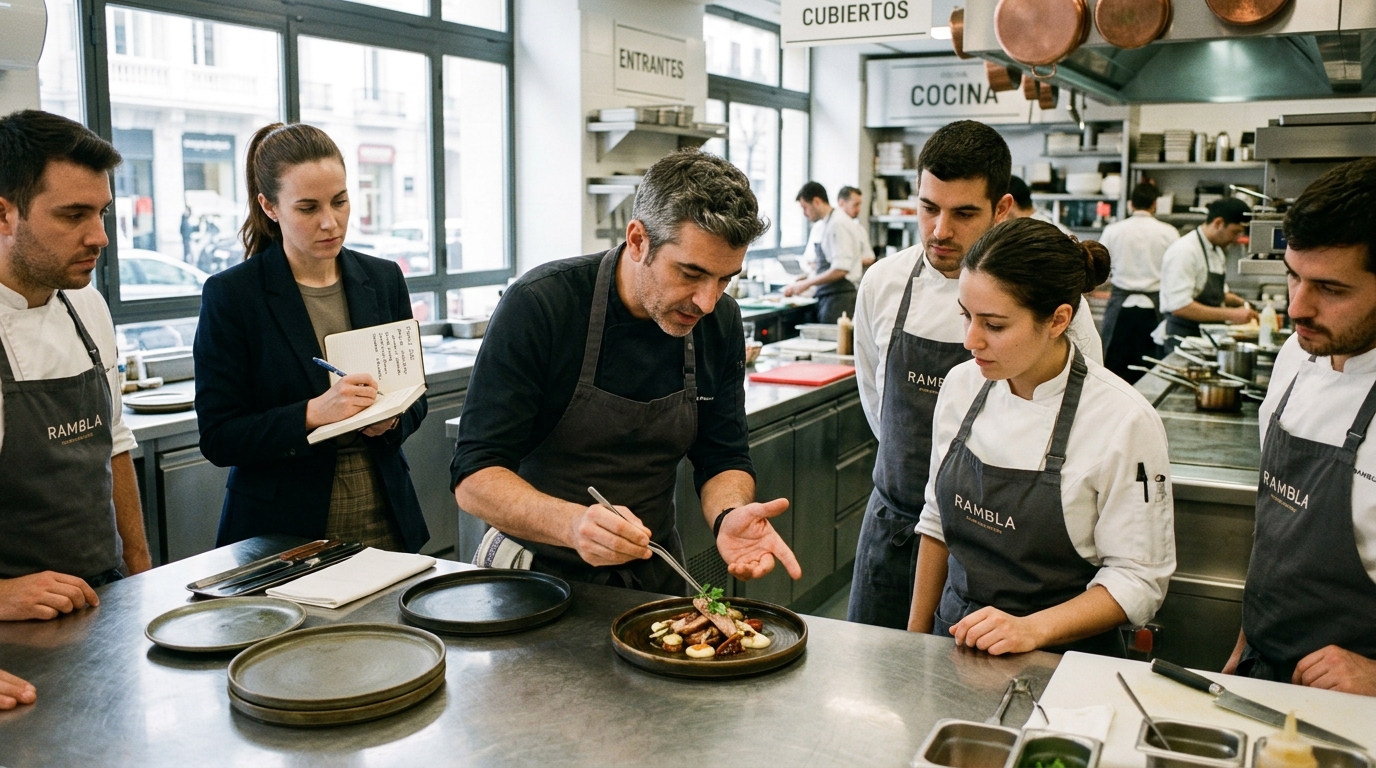
There are specific situations where the services of a gastronomic consultant are especially valuable. The most common scenarios are detailed below:
Situation 1: Menu design or redesign
When a restaurant needs to create a new menu, update its existing offer or reorient its culinary proposal, the gastronomic consultant provides the necessary technical knowledge. The professional analyzes the establishment's target, studies the local competition, defines the gastronomic philosophy and structures a balanced menu that maximizes turnover and profitability.
Signs that you need this service: Low dish turnover, unbalanced menu, lack of culinary identity, need to update the offer without losing customers.
Situation 2: Food cost control and optimization
Food cost is one of the main indicators of profitability in restaurants. A gastronomic consultant can analyze the cost structure, identify deviations, optimize recipes and establish control systems that improve the establishment's margins.
Signs that you need this service: Food cost higher than the sector target (25-35%), inexplicable variations in margins, difficulties in calculating real dish costs, high waste of raw materials.
Situation 3: Kitchen team training
When a restaurant incorporates new staff, needs to update techniques or maintain quality consistency, the training imparted by a gastronomic consultant is essential. The professional transmits their knowledge directly to the kitchen team, guaranteeing the standardization of processes.
Signs that you need this service: Inconsistency in the quality of the dishes, high turnover of kitchen staff, lack of technical knowledge in the team, need to introduce new techniques.
Situation 4: Gastronomic research and development
Restaurants that seek to differentiate themselves through exclusive culinary proposals can benefit from gastronomic R&D services. The gastronomic consultant develops new recipes, explores innovative techniques and creates differentiated proposals that raise the perceived value of the establishment.
Signs that you need this service: Desire to position the restaurant as a culinary benchmark, need to create exclusive dishes, interest in gastronomic innovations.
Find the ideal professional
Compare 219+ verified gastronomic consultants in Spain. Filter by city, specialty and type.

7. When to hire a restaurant consultant
A restaurant consultant is essential in situations that require a strategic and global vision of the business. The most frequent scenarios include:
Situation 1: Opening a new restaurant
Opening a restaurant involves a multitude of decisions that determine its future success. A restaurant consultant accompanies the entrepreneur throughout the process: definition of the concept, feasibility study, location selection, operational design, financial planning and start-up.
Signs that you need this service: First restaurant, lack of experience in hospitality management, significant investment that requires minimizing risks.
Situation 2: Profitability problems
When a restaurant has losses or insufficient margins, the restaurant consultant performs a comprehensive diagnosis to identify the causes and propose solutions. Their financial and operational approach allows them to address complex problems that transcend simple kitchen management.
Signs that you need this service: Negative economic results, downward trend in profits, difficulties covering operating costs, need to optimize the business structure.
Situation 3: Expansion plans
Restaurants that seek to grow, whether through new openings, franchises or geographic expansion, require specific knowledge that the restaurant consultant provides. The professional designs the expansion model, structures the business for its replicability and accompanies the growth process.
Signs that you need this service: Interest in opening new points of sale, consideration of the franchise model, need to professionalize management for growth.
Situation 4: Franchises and licenses
The transformation of a restaurant into a franchise or obtaining licenses to operate under a foreign concept requires specific business structuring work. The restaurant consultant prepares the operating manuals, defines the standards, establishes the requirements and accompanies the selection of franchisees.
Signs that you need this service: Desire to franchise your concept, interest in operating a franchise, need to professionalize systems for expansion.
8. How to choose between both profiles
The choice between a gastronomic advisor and a restaurant consultant should be based on practical criteria related to the specific needs of each project. The following are guidelines for making an informed decision:
Evaluate your current situation
The first step is to clearly identify the problem or need you want to solve. If the focus is on the menu, recipes, food cost or kitchen, the gastronomic advisor is more suitable. If the problem is financial, operational, profitability or growth strategy, the restaurant consultant provides greater value.
Define the scope of the project
Specific and limited projects (development of a new menu, optimization of food cost) tend to fit better with the gastronomic advisor. Complex and long-term projects (complete opening, expansion plan) require the comprehensive vision of the restaurant consultant.
Consider your level of experience
Owners without prior experience in Hospitality can benefit greatly from the global approach of the restaurant consultant. Owners with experience in the kitchen but limitations in business management may need both profiles or one that combines both skills.
Analyze the available budget
Gastronomic advisory services usually have a lower cost per specific project, while strategic restaurant consulting represents a larger investment but with a broader impact on the business.
Look for the combined profile when necessary
As indicated above, many professionals integrate both specialties. If your project requires attention to both the product and the business, finding a consultant who offers comprehensive services may be the most efficient option.
Verify experience and specialization
Regardless of the chosen profile, it is essential to verify the professional's experience in projects similar to yours. Ask for references, request success stories and evaluate their knowledge of the Spanish hospitality sector.
Still deciding? Our practical guide on how to choose a restaurant consultant gives you the criteria, interview questions and red flags to pick with confidence. Then explore our directory of 219+ verified gastronomic consultants in Spain to find the right professional for your project.